Posts Tagged ‘Interviews’

Interview with Tim Pratt

SCI FI Weekly just published a Q&A interview I did with Tim Pratt. Here’s a snippet:

What would you do with a zombie army?

Pratt: My house would be kept so clean! Except for the bits of zombie falling off here and there. Seriously, though, what wouldn’t I do? Zombies for all the menial tasks I hate! (Nothing involving food prep, natch, but yardwork? Definitely.) Plus, I would have the single greatest haunted house in the world each Halloween.
 

Read the whole interview!

"Retrospect" by Ann Miller

image Ann Miller, whose story "Retrospect" appears in the February 2008 issue of F&SF, said in an interview that the story actually started as a poem. "I was fooling around with the idea of how different books, if they were sent back in time, would change history and working with the play of ideas when I realized I’d need a larger vehicle to explore the concept properly," she said. "The first line of the story was initially the first line of my poem."

The story concerns a fledging auction agent who unwittingly gets involved with a circle of book lovers who are considering sending a book back in time, Miller said. "As the story develops, the protagonist discovers that the glittering world he has chosen, of high-stakes auction and finance, cannot sustain him and he gravitates toward his new circle of friends whom he feels are more genuine," she said. "They also ultimately betray him, and the unfolding of the narrative involves the choice the protagonist makes, given these experiences, when history has been changed and he has the chance to change it back."

(more…)

"Philologos; or, A Murder in Bistrita" by James D. Macdonald and Debra Doyle

image James D. Macdonald, whose story written in collaboration with his wife Debra Doyle, "Philologos; or, A Murder in Bistrita," appears in the February 2008 issue of F&SF, said in an interview that the story is about a scholar in search of a rare book. "With overtones of paranoia and undertones of unresolved sexual tension," he said. "It’s also an origin story for one of the non-protagonists but major supporting characters in [our novel] Land of Mist and Snow."

The origin of the story, Macdonald said, comes from a line in Land of Mist and Snow, in which one of the characters, Captain William R. Sharps, USN, says, in a letter to Commodore Vanderbilt: "I found the lost ur-text of the Grey Book (in the wine cellar of a fortress in Carpatho-Ruthenia — an amusing story, worth telling over brandy and cigars, but not germane to my present communication), and bent my energies toward transcribing and translating those portions which had been purged from the younger MSS."

But the reader never does hear that "amusing story" in the course of the novel, Macdonald said. "In fact, I had no idea when writing the novel what the story was that he had to tell. But that line sat in the back of my mind and the story asked to be told."

(more…)

"If Angels Fight" by Richard Bowes

image Richard Bowes, whose story "If Angels Fight" appears in the February 2008 issue of F&SF, said in an interview that the story was inspired by a trip he and his sister made to the old neighborhood. "It brought back a lot of memories including the politicians. I knew kids whose fathers were in politics. But politics was almost like popular entertainment–everyone knew about it, talked about it, rated politicians," Bowes said. "And the Kennedy family was a constant presence. JFK’s mother came from there. It was where her father, ‘Honey Fitzgerald’ had his mansion, until it burned down one night. Her relatives still lived in the neighborhood. The story’s roots were my trying to give a feeling for that lost, almost mythic moment. John F. Kennedy himself makes and appearance as an impatient young senator who’d just had to attend an aging relative’s birthday party."

"If Angels Fight" starts with the unnamed narrator being asked by Carol Bannon, the scion of a Boston political dynasty to help her find her long lost brother Mark who was a childhood friend of the narrator. "The narrator has helped the family with this several times over the years. The difficulty tracing Mark Bannon is that to all intents and purposes he died some years before," Bowes said. "The rest of the story is the narrators search in the byways of intrigue and politics and his memories of Irish Boston in the 1950’s when politics was a sport, a hobby, a way of life."

(more…)

"Balancing Accounts" by James L. Cambias

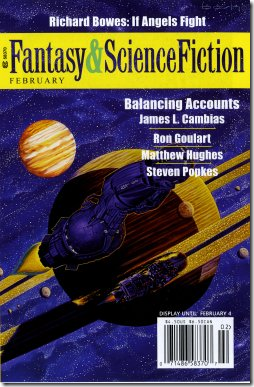
imageJames L. Cambias, whose story "Balancing Accounts" is the cover story of the February 2008 issue of F&SF, said in an interview that the story is about a small-time independent robotic space tug called Annie who is hired by a mysterious client for a voyage between two of Saturn’s moons.  "During the voyage Annie learns the true nature of her cargo and must fight off pursuers determined to capture or destroy what she’s carrying," Cambias said.

"Balancing Accounts" is Cambias’s attempt to update an old space-opera trope: the scruffy, hand-to-mouth space merchant crew. "I tried to make it work without violating physical laws or realistic economics," he said. "That meant it had to be within the Solar System (no faster-than-light drives) and couldn’t involve a human crew."

The protagonist, Annie, is a robot rocket tug who hauls cargo among the moons of Saturn.  "She’s autonomous and ‘incentivized’ — her purpose is to generate income for her owners back on Earth and Mars, and can more or less do whatever she chooses in order to do so," Cambias said. "But Annie has learned that there’s more to life than just earning micrograms of Helium-3; she works just as hard to accumulate ‘non-quantifiable assets’ like the goodwill of her fellow robots, a reputation for honest dealing, and what a human might call friendship."

(more…)

"The Quest for Creeping Charlie" by James Powell

image James Powell, whose story "The Quest for Creeping Charlie" appears in the January 2008 issue of F&SF, said in an interview that the story is about a man who sets out to find a creature called the megamensalopes. "In the early 1950s in Toronto George Muir, a university student, finds this quotation in a book: ‘When asked to name the smartest of all the animals an ancient wise man replied, "Surely the megamensalopes, because they have avoided discovery by man."’ Then and there Muir decides that he will set out on a quest to find the megamensalopes," Powell said.

Muir joins the Toronto branch of the Explorers Club and pores over maps of the remote corners of the world where he believes the creatures must exist. "Then he has a revelation. Perhaps the creatures needed to live close to man where they could learn from him while, at the same time, avoiding discovery. Perhaps they were right there in Toronto," Powell said. "So he begins his search closer to home, using all his free time to find the creatures. He decides they graze on the common ground ivy Canadians call Creeping Charlie and because ‘megamensalope’ is too much of a mouthful and because we are what we eat he names his quarry ‘Creeping Charlie.’ His search costs him his marriage and his life in more ways that one."

(more…)

"Mars: A Traveler’s Guide" by Ruth Nestvold

image Ruth Nestvold, whose story “Mars: A Traveler’s Guide” appears in the January 2008 issue of F&SF, said in an interview that the story is about a tourist on Mars who is stranded alone after an accident caused by a major dust storm. "The tour guide [is] dead and the rover damaged," Nestvold said. "The only thing the tourist has that is working is the supposedly ‘intelligent’ computer system to try to help him or her figure out a way to survive."

Like most of her stories, this one was brewing for a long time before it came together. "I think the original seed was a lecture Michael Swanwick gave at a workshop I once attended that he called ‘How to Win a Hugo,’" Nestvold said. "The gist of it was to have a character stranded somewhere in the solar system in a desperate situation with next to no options. The character should then solve the problem using science–so base the story on a combination of a ton of research and whatever hand-waving you need to get past the bumps. Of course, this impressed me, especially given the promise Michael made, and it was in the back of my mind for quite a few years before it came together with the idea of telling a story in a series of database entries."

(more…)

"The Bone Man" by Frederic S. Durbin

image Frederic S. Durbin, whose story “The Bone Man” appears in the December 2007 issue of F&SF, said in an interview that his story tells the story of Conlin, a hit man who "rediscovers" the true spirit of Hallowe’en.

"On his way back to Chicago from a hit in tiny Enfield, Illinois, Conlin turns off the interstate for lunch and wanders into a small town among the fields and woods—a town that isn’t on his map," Durbin said. "He quickly discovers that he’s arrived on the day of the annual Hallowe’en parade, apparently a major event for this community; and he is intrigued by references to someone called ‘the Bone Man,’ a dancing skeleton that shows up every year as a kind of Grand Master of the parade."

Conlin’s curiosity is piqued by the locals’ apparent combination of dread and reverence for this figure, and especially by photos he’s shown: photos too old to be digital hoaxes, which indeed seem to depict an animated skeleton, Durbin said. "As he watches the town’s preparations for the evening, Conlin is drawn back into his childhood memories of the season and the sinister holiday for which he’s always had an affinity," he said. "Of course, Conlin, in the midst of the dark revelry, meets the Bone Man; and the specter is very real; and the encounter leaves Conlin forever changed (ominous chuckle)."

(more…)

"Finisterra" by David Moles

image David Moles, who makes his F&SF debut in the December 2007 issue said in an interview that his story "Finisterra" is about a would-be aeronautical engineer from a backward future Earth who finds her obscure skills unexpectedly in demand on a strange and distant planet.

"It’s a riff on an old theme — the skilled protagonist who’s called on to travel to a strange locale to do a job that only that protagonist can do, and who ends up changed by the experience," Moles said. "’Finisterra’ would mostly make sense, I think, to any SF reader back to the Golden Age — apart from the setting, it would probably make sense to Joseph Conrad and Mark Twain."

The first inspiration for "Finisterra" was an illustration called "The Engineer," Moles said. "[The illustration was] an homage to Vermeer’s ‘Geographer,’ by my good friend Lara Wells," he said. "[It's of] a woman in early modern costume working at a window, in a room full of illustrations and models for airships and Da Vinci flying machines. A woman in Da Vinci’s time wouldn’t have had the opportunities Da Vinci had, and Lara wanted to capture that — her Engineer is trapped in that room, dreaming of flight but unable to fly. The character of Bianca Nazario came directly from that image, though I transplanted her to a different time and place, and gave her a means of — qualified — escape."

(more…)

The Slush God Speaketh…to Kevin N. Haw

The September 2007 issue features a story by one of my more recent slush survivors, “Requirements for the Mythology Merit Badge” by Kevin N. Haw. Click on the extended entry to read an interview I did with Kevin.

(more…)